What has been reported
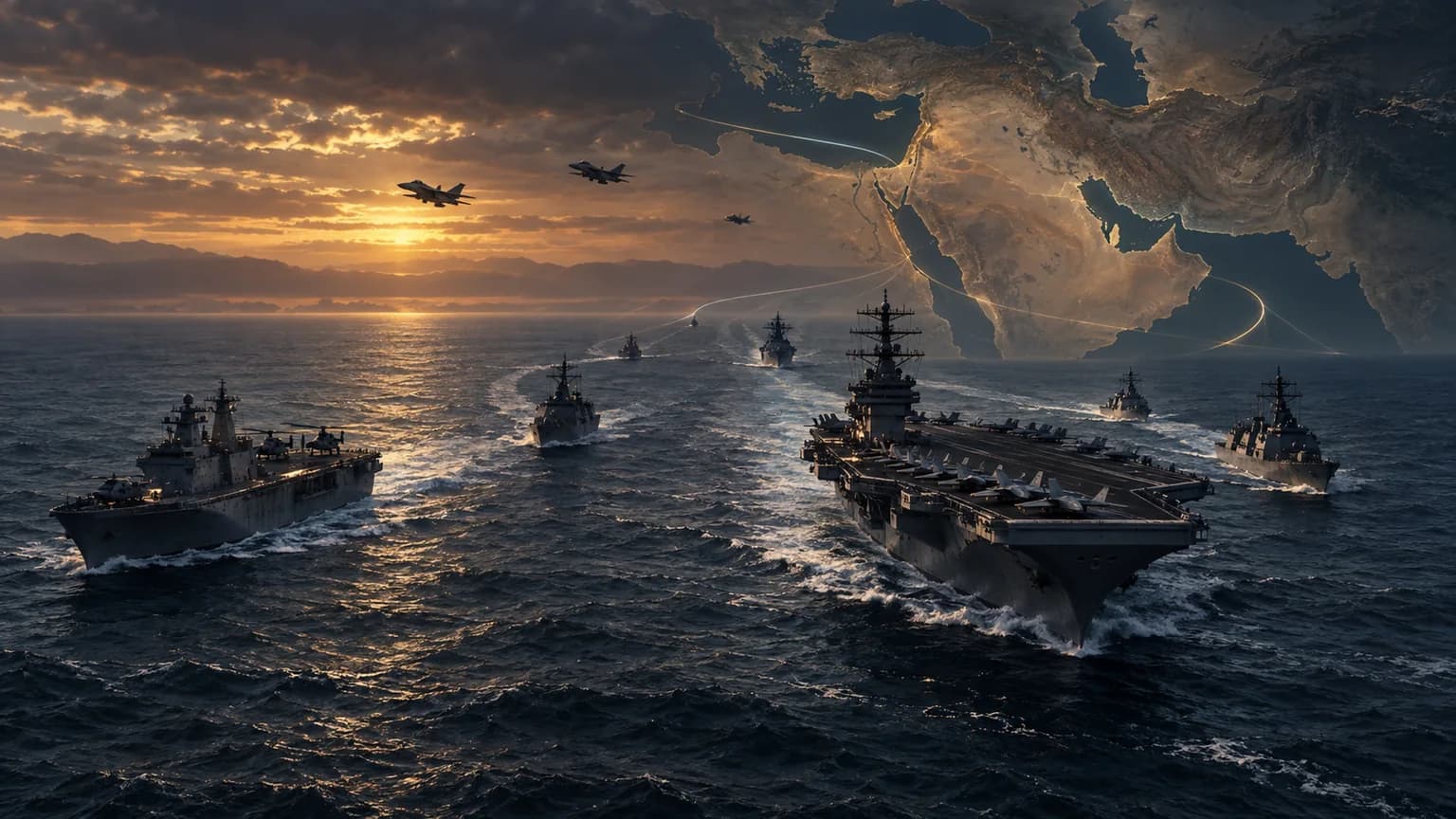
The United States dispatched the USS Theodore Roosevelt carrier strike group and the USS Makin Island amphibious ready group toward the Middle East with roughly 9,000 sailors and Marines. Their arrival could briefly place three U.S. carrier groups in the region and raise the naval presence above 20,000 personnel during the active Iran conflict. The movement is a significant force-concentration development, but it does not establish World War III or the Sixth Trumpet.
A U.S. Navy report published through DVIDS confirms that USS Theodore Roosevelt departed San Diego for the Middle East as part of the ongoing U.S. military operation in the region.
The Associated Press reported that the movement includes the Theodore Roosevelt carrier strike group, accompanied by USS Chosin, and the USS Makin Island amphibious ready group with USS John P. Murtha and USS Anchorage. A U.S. official placed the combined movement at more than 7,000 sailors and 2,000 Marines.
AP reported that the deployment could put three U.S. aircraft carriers in the region as early as late October. With forces already present, the naval concentration could exceed 20,000 sailors and Marines and include hundreds of aircraft.
The Washington Post independently reported planning for as many as three carrier groups and noted that the deployments are intended to give national leaders and commanders additional options while renewed strikes against Iran remain under consideration.
The reported three-carrier presence is a possible overlap, not a confirmed permanent expansion. Some newly arriving ships may replace forces already deployed for months, and the final size and duration of the concentration remain unsettled.
This is recorded as a new dated entry because it documents a discrete force deployment, new personnel movement, and a materially expanded set of near-term military options. Earlier records remain historical snapshots of other incidents and alliance actions in the conflict.
Why this is being watched
This is a significant watch development because an additional carrier strike group and amphibious ready group are moving toward an active state-on-state conflict, adding thousands of personnel, naval aviation, missile-defense capacity, and an embarked Marine expeditionary force. A temporary concentration of three carrier groups would be an unusually large U.S. naval posture for the region and could increase both deterrence and escalation risk. The evidence establishes a major deployment and planning flexibility—not a decision to begin a new offensive, a permanent three-carrier presence, or the prophetic event itself.
The deployment increases the military capacity available around Iran and may prepare conditions for renewed strikes, expanded maritime operations, evacuation missions, or other contingencies. If the arriving forces overlap with those already present rather than simply replacing them, it would mark a sharper concentration of U.S. power in a conflict already involving regional allies, shipping routes, and multiple fronts.
The evidence does not prove that renewed strikes have been ordered, that all three carrier groups will operate together for an extended period, that the amphibious force will conduct ground operations, or that a wider international war is inevitable. It does not establish that the four angels bound at the Euphrates have been released, that this is the Euphrates-centered event in Revelation 9, that an army numbered at two hundred million has assembled, that the fire, smoke, and brimstone markers are present, that one third of mankind has been killed, or that World War III or the Sixth Trumpet has begun.
The Sixth Trumpet and War at the Euphrates
Direct war, regional alliances, military mobilization, weapons of mass destruction, and events centered on or spreading through the Euphrates and Persian Gulf region are tracked without treating preliminary conditions as fulfillment.
United States and Iranian forces are directly exchanging strikes, including attacks involving warships, ballistic missiles, military bases, and oil tankers.
The conflict includes direct U.S.-Iran exchanges, attacks on Saudi cities and infrastructure, expanding operations in Yemen, repeated attacks on commercial shipping near Hormuz and in the Black Sea, and renewed long-range strikes in the Russia-Ukraine war.
Saudi Arabia, Türkiye, and Pakistan are coordinating collective-defense planning; Türkiye says parliamentary approval would be required and no final decision on assistance has been made. Britain, France, and the United States have also increased regional support or deployments. No broader force matching Revelation 9 is established.
No reviewed evidence establishes the immense force numbered in Revelation 9:16.
The catastrophic mortality described in Revelation 9:18 has not occurred.
Passages connected with this watch
Open any reference in the site’s Scripture reader to study the passage in context.
Reporting and primary materials
Sources are preserved with the dated entry so readers can distinguish reporting, primary claims, government policy, and Watchman 33 interpretation.
Primary U.S. military report confirming Theodore Roosevelt's departure from San Diego for the Middle East as part of the ongoing operation.
Primary news account for the approximately 9,000-person movement, named carrier and amphibious groups, possible three-carrier overlap, and projected regional naval concentration.
Independent reporting on the potential three-carrier posture, aggregate force capacity, deployment timing, and administration planning context.
Additional military-focused reporting that confirms the departures while emphasizing uncertainty about whether the arriving groups will overlap with or replace existing forces.
Source and image policy: Watchman 33 stores links, attribution, fact notes, and review dates. Full copyrighted articles are not republished. Entry images must be original, licensed, public-domain, or used with permission.