What has been reported
Houthi forces advanced along Yemen's west coast toward the Bab el-Mandeb Strait as fighting and cross-border attacks intensified. The Saudi-led coalition said it intercepted a Houthi ballistic missile launched toward Riyadh, Britain authorized an RAF Voyager to refuel Saudi defensive aircraft, and AP, Reuters, and AFP have reported attributed evidence of direct Iranian Revolutionary Guard operational assistance to the Houthi offensive and consolidation. The widening conflict is relevant to the Sixth Trumpet watch, but it does not establish the events or scale described in Revelation 9.
In a September 15 Security Council briefing, the United Nations said fighting had intensified along Yemen's west coast as the Houthis advanced toward Bab el-Mandeb and reportedly captured several southern Red Sea islands. The UN also reported a government counteroffensive, extensive airstrikes, clashes across multiple Yemeni front lines, and at least 125,000 people displaced since the start of September.
The same UN briefing recorded Houthi missile and drone attacks inside Saudi Arabia, including injuries and damage in Abha, Khamis Mushait, and Taif, while an attack attributed to Iran-aligned forces in Iraq had shut the kingdom's East-West oil pipeline for repairs.
Reuters reported on September 16 that Saudi-backed forces acknowledged airstrikes on Houthi positions as the Houthis consolidated gains near the strait. Claims by the Houthis—including that they downed a Saudi fighter jet—were not independently established and are not treated as confirmed facts in this assessment.
Two regional officials told the Associated Press that Saudi Arabia was running low on missile interceptors and had requested air-defense support from France, Britain, Pakistan, and Egypt. Saudi officials had not confirmed that request when AP published its report, so it remains an attributed claim rather than an official Saudi announcement.
Saudi Arabia officially said it intercepted a Houthi drone launched toward Makkah before it entered restricted airspace; the Houthis denied targeting the city. On September 17, AP reported that Saudi civil-defense officials said debris from an intercepted Houthi drone killed one person and injured two others in Taif province, without specifying when that incident occurred.
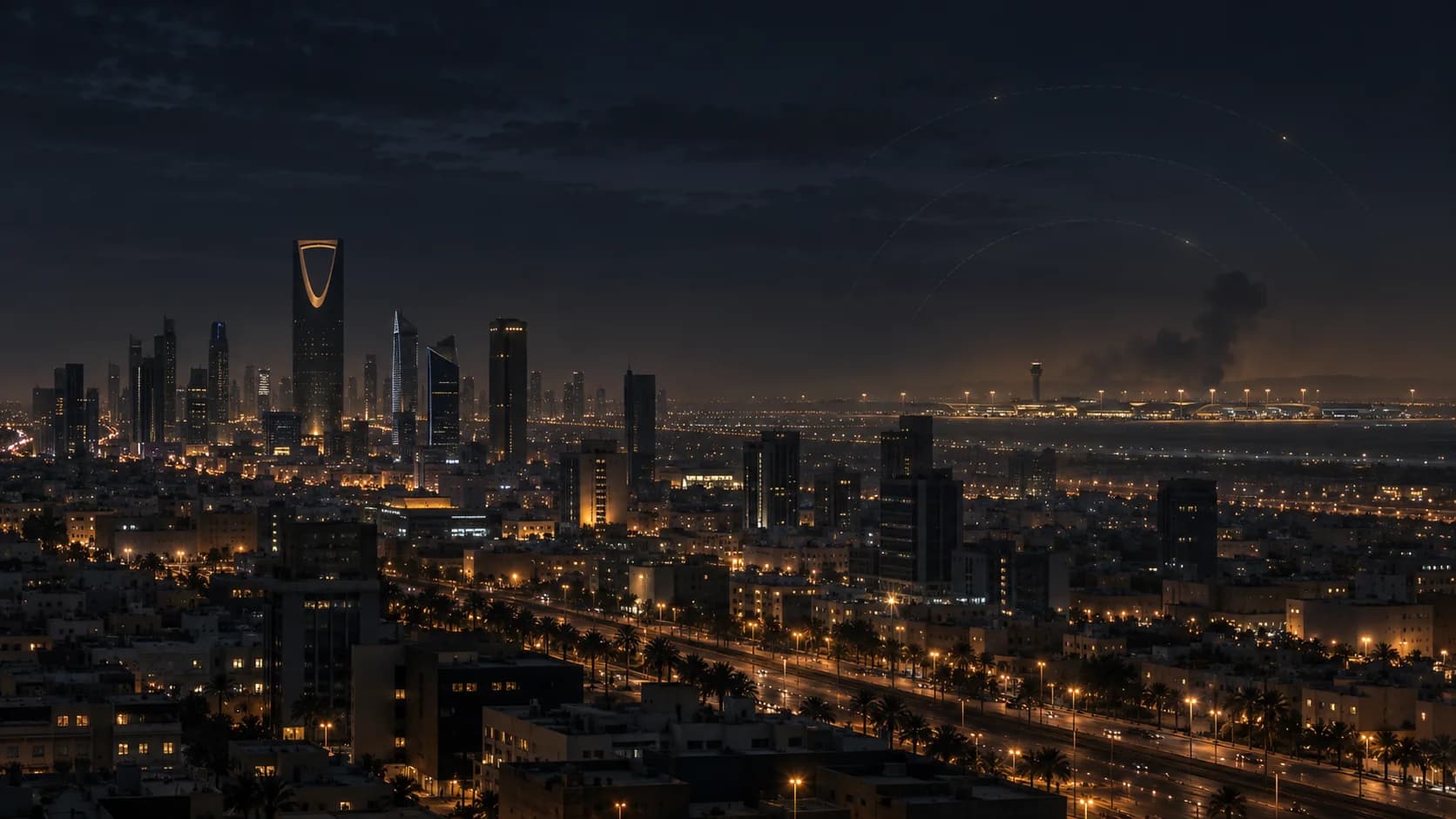
On September 19, Saudi civil defense sent phone alerts warning of potential aerial danger in Riyadh and Al-Kharj, then issued an all-clear. Associated Press reported that at least one explosion was heard in Riyadh and described the alert as the first for the capital since the latest Saudi–Houthi escalation; it reported no confirmed casualties or damage.
Reuters independently reported that a journalist heard booms and that its video and photographs showed smoke near King Khalid International Airport. At the time of that report, Saudi authorities had not explained the smoke or alerts, and neither report established the cause or Houthi responsibility.
The Saudi Press Agency subsequently published a coalition statement saying Saudi air defenses had intercepted and destroyed a ballistic missile launched by the Houthis toward Riyadh. Associated Press separately reported the coalition's attribution and recorded a broader Houthi claim that it had attacked sensitive sites in Riyadh and Saudi energy facilities; AP could not independently verify those Houthi claims. The coalition statement confirms the missile threat and intended target, but it does not establish that the airport-area smoke was caused by a missile impact, so that point remains unresolved.
On September 21, Reuters reported, citing five Yemeni military sources, that Houthi forces were pushing to seize the Kahboub mountain area between Taiz and Lahij. The reported move would help secure positions captured around Bab el-Mandeb and could open additional fronts against Saudi-backed forces. Reuters also reported that the fighting threatens a Saudi alternative oil route as the kingdom redirects exports toward the Strait of Hormuz.
Reuters relayed a New York Times report that President Donald Trump had prepared strikes against Houthi targets and then called them off, but Reuters said it could not independently verify that account and that U.S. Central Command did not comment. Axios separately reported, citing two U.S. officials, that the president considered but withheld strikes. These reports establish serious deliberation according to attributed sources, not an officially confirmed United States attack decision.
A senior Houthi official told Associated Press that the group had indirect contacts with the United States through Oman, did not intend to attack non-Saudi shipping, and could fight on multiple fronts. Those statements are the official's claims and are not treated as independent proof of Houthi capability or intent. AP separately reported that the World Health Organization counted 164 deaths and 516 injuries from September 13 through 18, while the International Organization for Migration counted 129,438 displaced people.
On September 22, the United Kingdom's Ministry of Defence officially announced that Britain would provide an RAF Voyager air-to-air refueling aircraft to support Saudi defensive activity following a Saudi request. The ministry said the new assistance builds on British air-defense equipment and personnel already deployed in Saudi Arabia to help protect against missile and drone attacks.
Associated Press and Reuters independently reported that the refueling agreement is time-limited, will be reviewed, and is expected to begin in the coming days with one Voyager aircraft. British officials described the mission as support for Saudi aircraft conducting defensive operations; this record does not recast that authorization as approval for British participation in offensive strikes.
Reuters reported on September 10, citing Yemeni government, Iranian, and regional sources, that Revolutionary Guard personnel provided direct guidance for the Houthi drive along the Red Sea coast. Iran publicly denies directing the Houthis, and the specific operational claims remain attributed rather than officially confirmed.
AFP reported on September 19, citing two Houthi military sources, that Iranian experts visited newly captured positions near Mokha and Bab el-Mandeb, supervised tunnel excavation, and discussed radar installations near Mokha and on Zuqar Island. Neither Iran nor the Houthis publicly confirmed those visits.
On September 23, Associated Press published a reconstruction based on interviews with ten officials and soldiers, including a senior Houthi official, regional officials, a senior Yemeni commander, and a member of Yemen's presidential council. AP reported that Iranian advisers helped plan tactical maneuvers and worked with front-line commanders during the rapid coastal offensive. This provides strong independent corroboration of direct Iranian operational involvement while leaving the anonymous-source claims appropriately attributed.
Why this is being watched
This remains a significant watch development because an Iran-aligned force has made reported territorial gains at a strategic Red Sea chokepoint and is reportedly consolidating those gains with direct Iranian operational assistance. Independent AP, Reuters, and AFP reporting now provides materially stronger corroboration that Revolutionary Guard personnel helped direct the offensive and support military infrastructure near Bab el-Mandeb, although the accounts rely substantially on attributed sources and lack official Iranian confirmation. Britain has also authorized military enabling support for Saudi defensive operations. The combination increases direct state involvement, pressure on strategic waterways, and the risk of escalation or miscalculation. These remain conditions relevant to watching—not evidence that the Sixth Trumpet has been fulfilled.
Territorial movement toward Bab el-Mandeb, reported Iranian operational guidance and infrastructure support, the push for strategic highlands, attacks on Saudi territory and energy infrastructure, renewed Saudi-backed air operations, and the confirmed British refueling commitment show a conflict drawing military involvement across national borders while strategic waterways and a national capital remain under pressure. The corroborated reporting of Revolutionary Guard advisers working with Houthi commanders materially strengthens the evidence of organized state support within this incident cluster.
The evidence does not prove that the four angels bound at the Euphrates have been released, that the present fighting is centered on the Euphrates, that a two-hundred-million-member mounted force has assembled, that the fire, smoke, and brimstone markers of Revelation 9 are present, that one third of mankind has been killed, or that the conflict has become World War III. Bab el-Mandeb is a Red Sea chokepoint south of the Euphrates basin; geographic proximity to a broader regional war is not fulfillment by itself.
The Sixth Trumpet and War at the Euphrates
Direct war, regional alliances, military mobilization, weapons of mass destruction, and events centered on or spreading through the Euphrates and Persian Gulf region are tracked without treating preliminary conditions as fulfillment.
United States and Iranian forces are directly exchanging strikes, including attacks involving warships, ballistic missiles, military bases, and oil tankers.
The conflict includes direct U.S.-Iran exchanges, repeated attacks on commercial shipping near Hormuz and in the Black Sea, deadly attacks at Saudi airports, an attack on an Aramco administrative building in Dhahran, renewed fighting across Yemen, and Saudi-supported operations around Bab el-Mandeb.
Britain and France have announced defensive support for Saudi Arabia, Saudi, Turkish, and Pakistani military chiefs have moved their joint-defense agreement into stated coordination, and the United States has sent another carrier and amphibious group toward the region. No broader international force matching Revelation 9 is established.
No reviewed evidence establishes the immense force numbered in Revelation 9:16.
The catastrophic mortality described in Revelation 9:18 has not occurred.
Passages connected with this watch
Open any reference in the site’s Scripture reader to study the passage in context.
Reporting and primary materials
Sources are preserved with the dated entry so readers can distinguish reporting, primary claims, government policy, and Watchman 33 interpretation.
Primary UN briefing documenting the Houthi advance toward Bab el-Mandeb, reported island captures, the counteroffensive, cross-border attacks, pipeline disruption, casualties, and displacement.
Reporting based on Yemeni government, Iranian, and regional sources that Revolutionary Guard personnel provided direct guidance for the Houthi coastal offensive. The account is retained as attributed reporting because Iran denies directing the Houthis.
Independent reporting on Houthi territorial gains near Bab el-Mandeb, renewed Saudi-backed airstrikes, attacks inside Saudi Arabia, and the competing claims of the parties.
Attributed report from two regional officials that Saudi Arabia sought air-defense support from France, Britain, Pakistan, and Egypt as interceptor supplies ran low.
Primary Saudi statement alleging that a Houthi drone was launched toward Makkah on September 15 and was intercepted before entering restricted airspace; the Houthi denial is retained in the briefing.
Report on Saudi civil-defense statements that interceptor debris killed one person, injured two, and damaged property in Taif province amid the expanding cross-border fighting.
Independent report that Saudi Arabia warned of a hostile aerial threat, issued the first Riyadh alert of the latest Saudi–Houthi escalation, and later gave an all-clear; AP reported an explosion was heard but no confirmed casualties or damage.
Independent eyewitness, video, and photographic reporting on booms, aerial-danger alerts, an all-clear, and smoke near Riyadh's airport; Reuters recorded that Saudi authorities had not explained the smoke or alerts.
Primary coalition statement saying Saudi air defenses intercepted and destroyed a ballistic missile launched by the Houthis toward Riyadh. This is the official attribution for the missile threat, not independent proof of every surrounding claim.
Independent reporting on the Saudi-led coalition's confirmation that it intercepted a Houthi ballistic missile aimed at Riyadh. AP separately recorded broader Houthi claims about attacks in Riyadh and Yanbu and said those claims could not be independently verified.
Reporting based on five Yemeni military sources that Houthi forces were pushing into strategic highlands to secure positions around Bab el-Mandeb and potentially open new fronts; the report separately attributes, but does not independently verify, an account that United States strikes were prepared and called off.
Interview documenting the Houthi official's attributed claims about indirect United States contacts, shipping targets, and multi-front capacity; those claims are retained as claims rather than independently established facts.
Independent reporting providing updated World Health Organization casualty figures and International Organization for Migration displacement totals for the widening conflict.
Independent attributed reporting, citing two United States officials, that President Trump considered but withheld strikes against Houthi targets; the White House and Saudi embassy did not confirm the account.
Primary British government announcement authorizing an RAF Voyager air-to-air refueling aircraft to support Saudi defensive activity and confirming that the assistance builds on existing British air-defense equipment and personnel in Saudi Arabia.
Independent reporting that the time-limited agreement will use one RAF Voyager, is expected to begin in the coming days, and is described by British officials as support for defensive Saudi missions.
Independent reporting on the Saudi request, British authorization, limited duration, planned deployment of one Voyager aircraft, and the United Kingdom's stated regional-stability rationale.
AFP reporting based on two Houthi military sources that Iranian experts visited positions near Mokha and Bab el-Mandeb, supervised tunnel excavation, and discussed radar installations. Neither Iran nor the Houthis officially confirmed the visits.
Independent reconstruction based on interviews with ten officials and soldiers reporting that Iranian advisers helped plan tactical maneuvers and worked with front-line Houthi commanders. The operational claims remain explicitly attributed.
Source and image policy: Watchman 33 stores links, attribution, fact notes, and review dates. Full copyrighted articles are not republished. Entry images must be original, licensed, public-domain, or used with permission.